Las Vegas Air Force Station
Las Vegas Air Force Station (1956-1969) - A Cold War Air Force Radar Station first established in 1956 near Las Vegas, Clark County, Nevada. Named Las Vegas Air Force Station after the location. Initially assigned a Permanent ID of SM-163, later a Sage ID of Z-163. Abandoned by the Air Force in 1969 now Angel Peak FAA Radar Site with an FAA ID of QAS.
-
 Las Vegas Air Force Station Upper Site in 2015, CARSR in Radome, FPS-26A Tower Empty.
 -
 Las Vegas AFS, Lower Site now the Spring Mountain Youth Camp.
 -
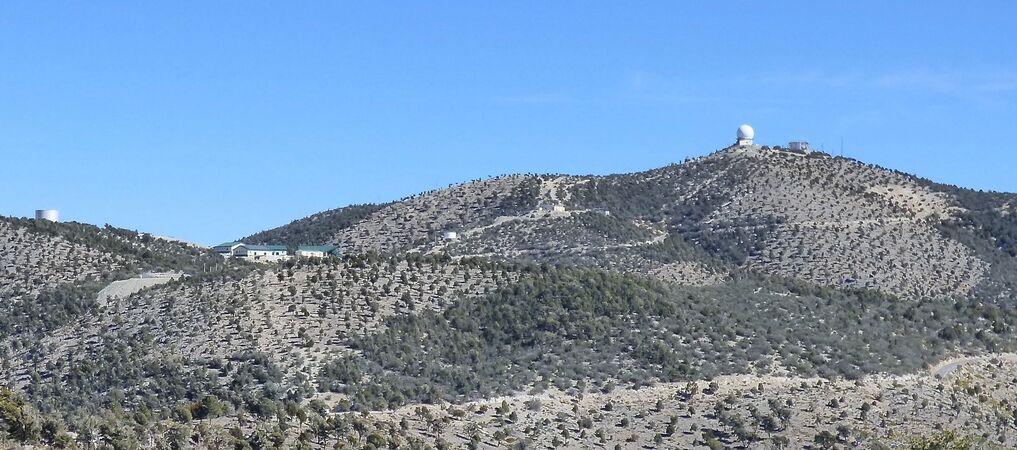 Las Vegas Air Force Station on Angel Peak, FAA Upper Site on the Right, Lower Site on the Left.


History
Established in 1956 and became operational on 1 April 1956 as Las Vegas Air Force Station manned by the 865th AC&W Squadron. The station initially had both a Ground-Control Intercept (GCI) and an early warning mission. The early warning mission involved tracking and identifying all aircraft entering their airspace while the GCI mission involved guiding Air Force interceptors to any identified enemy aircraft. Controllers at the station vectored fighter aircraft at the correct course and speed to intercept enemy aircraft using voice commands via ground-to-air radio.
Initial equipment included the FPS-3 search radar and an MPS-14 height-finder radar.
SAGE System Transition
The transition of the manual GCI system to the automated SAGE system began with the installation of the FST-2 coordinate data transmitter and search radar upgrades. The FST-2 equipment digitized the radar returns and transmitted the digital returns to the SAGE direction center. Under the SAGE System, interceptor aircraft were directed to their targets by the direction center computers and controllers, greatly reducing the need for local controllers and equipment at every radar station.
The FST-2 was a very large digital system using vacuum tube technology. Over 6900 vacuum tubes were used in each FST-2 requiring 21 air-conditioned cabinets, 40 tons of air conditioning, 43.5 kva of prime power, and usually a large new addition to the operations building. The FST-2B modification added two more cabinets but with newer solid-state (transistor) technology to process coded responses from aircraft transponders.
SAGE System Operation

| Assigned | Direction Center | Sector | |||||||||||||||||||||||||||||||
|---|---|---|---|---|---|---|---|---|---|---|---|---|---|---|---|---|---|---|---|---|---|---|---|---|---|---|---|---|---|---|---|---|---|
| 1 Oct 1959 - 1 May 1961 | Norton SAGE Direction Center DC-17 | Los Angeles Air Deense Sector | |||||||||||||||||||||||||||||||
| 1 May 1961 - 1 Apr 1966 | Luke SAGE Direction Center DC-21 | Phoenix Air Defense Sector | |||||||||||||||||||||||||||||||
| 1 Apr 1966 - 31 Dec 1969 | Luke SAGE Direction Center DC-21 | 27th Air Division
The site began operation as a SAGE site on 1 Nov 1959 initially feeding the Norton SAGE Direction Center DC-17 in San Bernardino, California. The search radar was upgraded to an FPS-20 in 1958 and an FPS-26A height-finder radar was installed in 1963. In 1961 Las Vegas AFS was an ADC/FAA joint-use facility and provided data for the FAA and the SAGE system. The FAA and USAF controllers both worked at the site operations building. The FPS-20 search radar was replaced with an FPS-27 search radar in the mid-1960s. The FAA retained the FPS-20A for their use. Control was transferred on 1 May 1961 to the Luke SAGE Direction Center DC-21 in Phoenix, Arizona Gap Fillers
|
