Vancouver Barracks: Difference between revisions
John Stanton (talk | contribs) No edit summary |
John Stanton (talk | contribs) No edit summary |
||
| Line 11: | Line 11: | ||
==Vancouver Barracks History== | ==Vancouver Barracks History== | ||
[[Image:Fort Vancouver Mansfield Plan.jpg|thumb|left|300px|Fort Vancouver Plan 1854]] | [[Image:Fort Vancouver Mansfield Plan.jpg|thumb|left|300px|Fort Vancouver Plan 1854]] | ||
The Treaty of 1846 established the present day boundary between the U.S. and what is now Canada, settling a long dispute between Britain and the U.S. over ownership of the Oregon Territory (Washington and Oregon). In 1849 Captain [[John S. Hatheway]] and two companies of the [[1st U.S. Artillery]] arrived to established a U.S. presence near the [[Hudson's Bay Company]] (HBC) [[Fort Vancouver]] and [[Fort Nisqually]]. The post at Fort Vancouver was called [[Columbia Barracks]] and was situated on a bluff above the HBC's [[Fort Vancouver]]. This post was not garrisoned until 1850 because quarters were not yet built. | The Treaty of 1846 established the present day boundary between the U.S. and what is now Canada, settling a long dispute between Britain and the U.S. over ownership of the Oregon Territory (Washington and Oregon). In 1849 Captain [[John S. Hatheway]] and two companies of the [[1st U.S. Artillery]] arrived to established a U.S. presence near the [[Hudson's Bay Company]] (HBC) [[Fort Vancouver (1)]] and [[Fort Nisqually]]. The post at Fort Vancouver was called [[Columbia Barracks]] and was situated on a bluff above the HBC's [[Fort Vancouver (1)]]. This post was not garrisoned until 1850 because quarters were not yet built. | ||
In 1850 Colonel [[Persifor F. Smith]], Commander of the Pacific Division, ordered the construction of quarters at Columbia Barracks and Captain [[Rufus Ingalls]] supervised the work. Additional buildings at Fort Vancouver were leased from the HBC. In 1853 [[Columbia Barracks]] was renamed [[Fort Vancouver (2)]]. | In 1850 Colonel [[Persifor F. Smith]], Commander of the Pacific Division, ordered the construction of quarters at Columbia Barracks and Captain [[Rufus Ingalls]] supervised the work. Additional buildings at Fort Vancouver were leased from the HBC. In 1853 [[Columbia Barracks]] was renamed [[Fort Vancouver (2)]]. | ||
| Line 17: | Line 17: | ||
In 1854 Colonel [[Joseph K.F. Mansfield]] conducted an inspection of the Department of the Pacific and he described the then [[Fort Vancouver (2)]] as "a beautiful site on the north bank of the Columbia River... in full view of Mounts Hood and Jefferson". His sketch of the plan of the fort is shown here. | In 1854 Colonel [[Joseph K.F. Mansfield]] conducted an inspection of the Department of the Pacific and he described the then [[Fort Vancouver (2)]] as "a beautiful site on the north bank of the Columbia River... in full view of Mounts Hood and Jefferson". His sketch of the plan of the fort is shown here. | ||
On 14 Jul 1860 the original [[Fort Vancouver]] was abandoned by the HBC and gradually deteriorated until it was destroyed by fire in 1866. On 5 Apr 1879 the U.S. [[Fort Vancouver]] was renamed Vancouver Barracks. | On 14 Jul 1860 the original [[Fort Vancouver (1)]] was abandoned by the HBC and gradually deteriorated until it was destroyed by fire in 1866. On 5 Apr 1879 the U.S. [[Fort Vancouver (2)]] was renamed Vancouver Barracks. | ||
Throughout the early history of Washington and Oregon and especially during the heyday of the Oregon Trail, Vancouver Barracks was a U.S. Army Headquarters and played a central role in the Indian Wars of the 1850's, 60's and 70's. | Throughout the early history of Washington and Oregon and especially during the heyday of the Oregon Trail, Vancouver Barracks was a U.S. Army Headquarters and played a central role in the Indian Wars of the 1850's, 60's and 70's. | ||
{{Clr}} | {{Clr}} | ||
== [[World War II]] (1941-1945) == | == [[World War II]] (1941-1945) == | ||
In [[World War II]] Vancouver Barracks was used as a | In [[World War II]] Vancouver Barracks was used as a staging area for the Seattle Port Of Embarkation. The post included 3,019 acres, had billeting space for 250 officers and 7,295 enlisted persons. | ||
==Current Status== | ==Current Status== | ||
In 1948 Congress designated Fort Vancouver and Vancouver Barracks as a National Monument. In 1961 the it became a National Historic Site and in 1996 Congress designated 366 acres that included Fort Vancouver, Vancouver Barracks and other surrounding sites as the Vancouver National Historic Reserve. | In 1948 Congress designated Fort Vancouver and Vancouver Barracks as a National Monument. In 1961 the it became a National Historic Site and in 1996 Congress designated 366 acres that included Fort Vancouver, Vancouver Barracks and other surrounding sites as the Vancouver National Historic Reserve. | ||
| Line 50: | Line 50: | ||
'''Links:''' | '''Links:''' | ||
* [http://www.northamericanforts.com/West/wa2.html#barracks North American Forts- Vancouver Barracks] | * [http://www.northamericanforts.com/West/wa2.html#barracks North American Forts- Vancouver Barracks] | ||
* [http://en.wikipedia.org/wiki/Fort_Vancouver Wikipedia - Fort Vancouver] | |||
* [http://www.nps.gov/fova/ Fort Vancouver Historic Site] | * [http://www.nps.gov/fova/ Fort Vancouver Historic Site] | ||
{{Visited|26 Jul 2008, Aug 2005}} | {{Visited|26 Jul 2008, Aug 2005}} | ||
| Line 61: | Line 61: | ||
Image:Vancouver Barracks Officer Qtrs.jpg|Officer Quarters | Image:Vancouver Barracks Officer Qtrs.jpg|Officer Quarters | ||
Image:Vancouver Barracks Officer Qtrs 2.jpg|Officer Quarters | Image:Vancouver Barracks Officer Qtrs 2.jpg|Officer Quarters | ||
</gallery> | </gallery> | ||
Revision as of 11:54, 9 June 2011
Vancouver Barracks (1849-1947) - Established first as Columbia Barracks 13 May 1849 by Captain John S. Hatheway and two companies of the 1st U.S. Artillery in Clark County, Washington. Renamed Fort Vancouver (2) 13 Jul 1853 and finally named Vancouver Barracks 5 Apr 1879. Abandoned in 1947. See also Fort Vancouver (1).
 |
 |
 | |
Vancouver Barracks History

The Treaty of 1846 established the present day boundary between the U.S. and what is now Canada, settling a long dispute between Britain and the U.S. over ownership of the Oregon Territory (Washington and Oregon). In 1849 Captain John S. Hatheway and two companies of the 1st U.S. Artillery arrived to established a U.S. presence near the Hudson's Bay Company (HBC) Fort Vancouver (1) and Fort Nisqually. The post at Fort Vancouver was called Columbia Barracks and was situated on a bluff above the HBC's Fort Vancouver (1). This post was not garrisoned until 1850 because quarters were not yet built.
In 1850 Colonel Persifor F. Smith, Commander of the Pacific Division, ordered the construction of quarters at Columbia Barracks and Captain Rufus Ingalls supervised the work. Additional buildings at Fort Vancouver were leased from the HBC. In 1853 Columbia Barracks was renamed Fort Vancouver (2).
In 1854 Colonel Joseph K.F. Mansfield conducted an inspection of the Department of the Pacific and he described the then Fort Vancouver (2) as "a beautiful site on the north bank of the Columbia River... in full view of Mounts Hood and Jefferson". His sketch of the plan of the fort is shown here.
On 14 Jul 1860 the original Fort Vancouver (1) was abandoned by the HBC and gradually deteriorated until it was destroyed by fire in 1866. On 5 Apr 1879 the U.S. Fort Vancouver (2) was renamed Vancouver Barracks.
Throughout the early history of Washington and Oregon and especially during the heyday of the Oregon Trail, Vancouver Barracks was a U.S. Army Headquarters and played a central role in the Indian Wars of the 1850's, 60's and 70's.
World War II (1941-1945)
In World War II Vancouver Barracks was used as a staging area for the Seattle Port Of Embarkation. The post included 3,019 acres, had billeting space for 250 officers and 7,295 enlisted persons.
Current Status
In 1948 Congress designated Fort Vancouver and Vancouver Barracks as a National Monument. In 1961 the it became a National Historic Site and in 1996 Congress designated 366 acres that included Fort Vancouver, Vancouver Barracks and other surrounding sites as the Vancouver National Historic Reserve.
|
{"selectable":false,"width":"500"} |
Location: Adjacent to Vancouver City, Clark County, Washington. It borders US Interstate 5 just over the Columbia River bridge on the east side of the Interstate. Exit on East Plain Blvd. and follow the signs. Maps & Images Lat: 45.627049 Long: -122.659693 |
Recent Blog Posts:
Sources:
- Hart, Herbert M., Tour Guide to Old Western Forts, Pruett Publishing Co., Boulder CO, 1980, ISBN 0-87108-568-2, page 190
- Roberts, Robert B., Encyclopedia of Historic Forts: The Military, Pioneer, and Trading Posts of the United States, Macmillan, New York, 1988, 10th printing, ISBN 0-02-926880-X, page 838
- Frazer, Robert W. (editor), Mansfield on the conditions of The Western Forts, University of Oklahoma Press, Norman OK, 1963, ISBN 0-8061-1083-X, page 114-115, plan 23
- Billings, John Shaw, Circular 4, Barracks and Hospitals with Descriptions of Military Posts 1870, War Department, Surgeon General's Office, 5 Dec 1870, Washington DC, Google Books, page 421
Links:
Visited: 26 Jul 2008, Aug 2005
Picture Gallery
|
Click on the picture to see a larger version. Contribute additional pictures - the more the better! |
-
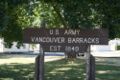 Vancouver Barracks Sign
 -
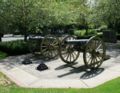 Replica Cannon
 -
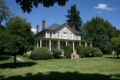 Officer Quarters
 -
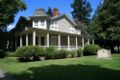 Officer Quarters


