Fort Pickens: Difference between revisions
John Stanton (talk | contribs) No edit summary |
John Stanton (talk | contribs) No edit summary |
||
| Line 1: | Line 1: | ||
{{SocialNetworks}} | {{SocialNetworks}} | ||
'''{{PAGENAME}}''' (1829-1947) - Construction began in 1829 and was completed in 1934. Originally designed by [[Simon Bernard]] and | '''{{PAGENAME}}''' (1829-1947) - A [[:Category:Third System Forts|Third System]] brick fort with nine [[:Category:Endicott Period Forts|Endicott Period]] batteries and three [[World War II]] batteries installed in and around the fort. Construction began in 1829 and was completed in 1934. Originally designed by [[Simon Bernard]] and [[Joseph Totten]]. Named after Gen. [[Andrew Pickens]]. Decommissioned in 1947. | ||
{{Clr}} | {{Clr}} | ||
[[Image:FortPickens_Map_1861.jpg|300px|thumb|left|Map of Fort Pickens 1861]] | [[Image:FortPickens_Map_1861.jpg|300px|thumb|left|Map of Fort Pickens 1861]] | ||
| Line 8: | Line 8: | ||
Constructed to provide protection for the entrance to Pensacola Harbor along with [[Fort Barrancas]], [[Fort McRee]] and the [[Advanced Redoubt]]. | Constructed to provide protection for the entrance to Pensacola Harbor along with [[Fort Barrancas]], [[Fort McRee]] and the [[Advanced Redoubt]]. | ||
Construction was supervised by Col. [[William Chase]]. | The original design by [[Joseph Totten]] was modified by his superior [[Simon Bernard]] so that the two seacoast fronts reflect the Totten design while the other three sides reflect the simpler Bernard design. As built, the fort had two, 1000' long seacoast fronts with dual gun casemates and a barbette tier on top. The two secondary fronts were shorter with casemates that served as gun rooms and crew quarters. A backfilled wall and gorge with massive bastions protected the landward side from attack down the island. The seacoast fronts had modified demibastions at each end and a small tower bastion at the center. Armament was to have been 252 guns of different types and caliber. The Peacetime garrison was designed for 100 troops with a wartime capacity of 1,260 troops. Construction was supervised by Col. [[William Chase]]. | ||
==[[U.S. Civil War]]== | ==[[U.S. Civil War]]== | ||
Florida left the Union 10 Jan 1861 and secessionists seized [[Fort Barrancas]], [[Fort McRee]] and the [[Advanced Redoubt]], only Fort Pickens remained in Union hands and it effectively blocked Confederate use of Pensacola Harbor. | Florida left the Union 10 Jan 1861 and secessionists seized [[Fort Barrancas]], [[Fort McRee]] and the [[Advanced Redoubt]], only Fort Pickens remained in Union hands and it effectively blocked Confederate use of Pensacola Harbor. | ||
<gallery> | |||
Image:FortPickens Bombardment 1861.jpg|Bombardment of Fort Pickens Nov 1861 | |||
Image:SantaRosaIslandCamp.jpg|Camp Brown, Fort Pickens in Background, 1861 | |||
Image:BattleSantaRosa.jpg|Battle of Santa Rosa Island, 9 Nov 1861 | |||
Image:SantaRosaIslandMap 1861.jpg|Map of Santa Rosa Island, 1861 | |||
</gallery> | |||
The [[6th New York Volunteer Infantry]] landed on Santa Rosa Island 26 Jun 1861 from the side-wheel steamship Vanderbilt and encamped at [[Camp Brown]], about one mile east of Fort Pickens. [[Camp Brown]] was attacked on the night of 9 Oct 1861 by Confederate forces who destroyed most of the camp before being driven off with help from Fort Pickens reinforcements. On 22-23 Nov 1861 and 1 Jan 1862 Fort Pickens and it's exterior batteries came under bombardment from Confederate held forts and batteries. By May 1862 Confederate forces had abandoned attempts to take Fort Pickens, withdrawn from the Pensacola area and all of the Pensacola Harbor defenses had been returned to Union control. | The [[6th New York Volunteer Infantry]] landed on Santa Rosa Island 26 Jun 1861 from the side-wheel steamship Vanderbilt and encamped at [[Camp Brown]], about one mile east of Fort Pickens. [[Camp Brown]] was attacked on the night of 9 Oct 1861 by Confederate forces who destroyed most of the camp before being driven off with help from Fort Pickens reinforcements. On 22-23 Nov 1861 and 1 Jan 1862 Fort Pickens and it's exterior batteries came under bombardment from Confederate held forts and batteries. By May 1862 Confederate forces had abandoned attempts to take Fort Pickens, withdrawn from the Pensacola area and all of the Pensacola Harbor defenses had been returned to Union control. | ||
Revision as of 16:31, 16 March 2008
Fort Pickens (1829-1947) - A Third System brick fort with nine Endicott Period batteries and three World War II batteries installed in and around the fort. Construction began in 1829 and was completed in 1934. Originally designed by Simon Bernard and Joseph Totten. Named after Gen. Andrew Pickens. Decommissioned in 1947.


Fort Pickens History
Constructed to provide protection for the entrance to Pensacola Harbor along with Fort Barrancas, Fort McRee and the Advanced Redoubt.
The original design by Joseph Totten was modified by his superior Simon Bernard so that the two seacoast fronts reflect the Totten design while the other three sides reflect the simpler Bernard design. As built, the fort had two, 1000' long seacoast fronts with dual gun casemates and a barbette tier on top. The two secondary fronts were shorter with casemates that served as gun rooms and crew quarters. A backfilled wall and gorge with massive bastions protected the landward side from attack down the island. The seacoast fronts had modified demibastions at each end and a small tower bastion at the center. Armament was to have been 252 guns of different types and caliber. The Peacetime garrison was designed for 100 troops with a wartime capacity of 1,260 troops. Construction was supervised by Col. William Chase.
U.S. Civil War
Florida left the Union 10 Jan 1861 and secessionists seized Fort Barrancas, Fort McRee and the Advanced Redoubt, only Fort Pickens remained in Union hands and it effectively blocked Confederate use of Pensacola Harbor.
-
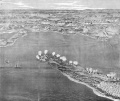 Bombardment of Fort Pickens Nov 1861
 -
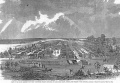 Camp Brown, Fort Pickens in Background, 1861
 -
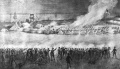 Battle of Santa Rosa Island, 9 Nov 1861
 -
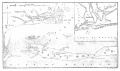 Map of Santa Rosa Island, 1861


The 6th New York Volunteer Infantry landed on Santa Rosa Island 26 Jun 1861 from the side-wheel steamship Vanderbilt and encamped at Camp Brown, about one mile east of Fort Pickens. Camp Brown was attacked on the night of 9 Oct 1861 by Confederate forces who destroyed most of the camp before being driven off with help from Fort Pickens reinforcements. On 22-23 Nov 1861 and 1 Jan 1862 Fort Pickens and it's exterior batteries came under bombardment from Confederate held forts and batteries. By May 1862 Confederate forces had abandoned attempts to take Fort Pickens, withdrawn from the Pensacola area and all of the Pensacola Harbor defenses had been returned to Union control.
Fort Pickens was not attacked again during the remainder of the war and served as a prison for military and political prisoners.
Post U.S. Civil War
Apache Indian chief Geronimo and 50 Chiricahua Apache men, women and children were imprisoned in Fort Pickens Oct 1886 to May 1888.
Endicott Period
| Battery Click on Battery links below |
No. | Caliber | Type Mount | Service Years | Battery Cost | Notes |
|---|---|---|---|---|---|---|
| Battery Pensacola | 2 | 12" | Disappearing | 1898-1898-1899-1933 | $ 128,707 | |
| Battery Worth (2) | 8 | 12" | Mortar | 1897-1899-1899-1942 | $ 123,093 | |
| Battery Cullum | 2 | 10" | Disappearing | 1896-1898-1898-1933 | $ 188,920 | 2-3" from Battery Trueman, 1942 |
| Battery Sevier | 2 | 10" | Disappearing | 1896-1898-1898-1933 | Included above | |
| Battery Cooper | 2 | 6" | Disappearing | 1905-1906-1906-1917 | $ 56,744 | 1 replaced 1976 (West Point) |
| Battery Van Swearingen | 2 | 4.7" | Pedestal | 1898-1898-1898-1921 | $ 7,498 | |
| Battery Trueman | 2 | 3" | Pedestal | 1905-1905-1908-1942 | $ 28,333 | Guns to Battery Cullum, 1942 |
| Battery Payne | 2 | 3" | Pedestal | 1904-1904-1908-1946 | $ 28,103 | |
| Source: CDSG | ||||||
World War II
| Battery Click on Battery links below |
No. | Caliber | Type Mount | Service Years | Battery Cost | Notes |
|---|---|---|---|---|---|---|
| Battery 234 | 2 | 6" | Shielded Barbette (SBC) | 1943-1943-1943-1947 | $ 212,482 | Gun tubes never received |
| Battery AMTB - Fort Pickens | 2 2 |
90mm 90mm |
Fixed Pedestal Mobile |
1943-1943-1943-1946 | $ 16,811 | |
| Battery 155 - Fort Pickens | 4 | 155mm | Tractor-drawn Panama Mount |
1942-1942-1942-1945 | $ 26,652 | Constructed around Battery Cooper |
| Source: CDSG | ||||||
Current Status
Fort Pickens is part of the Gulf Islands National Seashore and is administered by the National Park Service. Access to the fort was made difficult by Hurricane Ivan in 2004 because the Fort Pickens Road was washed out. Reconstruction is planned for 2008 and scheduled to be complete in the spring of 2009.
|
{"selectable":false,"width":"500"} |
Location: Western tip of Santa Rosa Island, Pensacola, Florida. Maps & Images Lat: 30.327 Long: -87.2907 |
Sources:
- Roberts, Robert B., Encyclopedia of Historic Forts: The Military, Pioneer, and Trading Posts of the United States, Macmillan, New York, 1988, 10th printing, ISBN 0-02-926880-X, page 195-198
- Weaver, John R. II, A Legacy in Brick and Stone: America Coastal Defense Forts of the Third System, Redoubt Press, McLean, 2001, First Printing, ISBN 1-57510-069-X, page 159-163
- De Quesada, Alejandro M., A History of Florida Forts: Florida's Lonely Outposts, SC : History Press, Charleston, 2006, ISBN 1596291044, page 192-193
- Morris, Gouverneur, The History of a Volunteer Regiment: Being a Succinct Account of the Organization, Services and Adventures of the Sixth Regiment New York Volunteers Infantry Known as Wilson Zouaves, Veteran Volunteer Publishing Company, New York, 1891
Links:
Visited: No
Fort Pickens Picture Gallery
|
Click on the picture to see a larger version. Contribute additional pictures - the more the better! |